Hard water, chlorine taste, crusty fixtures. Softeners and whole-house filters sized to your water, with a price before we start.
Written by Sergio, owner of Malibu Plumbing Pros. Last updated October 2026.
White crust on the shower glass. Spots on every wine glass. A kettle that sounds like it's full of gravel. If that's your house, you're not imagining it. Malibu tap water is hard, and I do water softener installation in Malibu, CA for folks who are done scrubbing. I'm Sergio, and you talk to me, not a call center.
Before I sell you anything, we look at the numbers from your own water report. Then we pick the right setup: a salt-based softener, a salt-free conditioner, a whole-house carbon filter, or a mix. Sometimes the honest answer is that you only need a filter. I'll tell you that too.
When Water Softeners & Whole-House Filtration May Be the Right Next Step
Sound familiar? These are the calls we get most.
White crust on faucets and glass
Chalky rings on shower doors, faucets and tile that come right back a week after you scrub them.
Soap won't lather
Shampoo barely foams, and your skin and hair feel dry and squeaky after a shower.
Cloudy, spotty dishes
Glasses come out of the dishwasher cloudy, even with rinse aid and the good soap.
Tap water tastes like a pool
A chlorine or chemical taste and smell at the kitchen sink, worse first thing in the morning.
Water heater pops and rumbles
Popping or rumbling from the tank. That's often mineral scale cooking on the bottom.
Old softener quit
The salt level never drops, it beeps, or the bypass leaks, and nobody has looked at it in years.
Water Softener Installation in Malibu, CA for Homes & Businesses
Homes & vacation rentals
For homes, water softener installation in Malibu, CA starts with sizing the system to your family and your pipes. I keep the garden hose bibs on unsoftened water so your plants get what they're used to.
For shops, restaurants and vacation rentals, I add filtration that protects ice machines, coffee gear and water heaters, with a simple filter schedule your staff can follow.
A softener has to go on the main water line, before the water heater, near a drain and an outlet. On a lot of Malibu homes that's not easy. The main may come up on a steep hillside, under a deck, or in a garage that's already packed. Some older houses have the main running through the slab.
Then there's the drain. A salt-based softener rinses itself every few days, and that salty rinse water has to go somewhere. The City of Malibu says onsite systems, the septic tanks and leach fields most people here call septic, handle the majority of the city's wastewater. So if you're on one, I talk with you about where that rinse water ends up before we choose a salt unit. Happens on pretty much every install out here, and it's worth the five minutes.
I also keep equipment out of direct sun and salt spray when I can. Plastic tanks and control heads last longer in a shady, covered spot.
How Hard Is Malibu Water, Really?
Most of Malibu gets its water from Los Angeles County Waterworks District 29. Its 2025 water quality report says the water comes from the Metropolitan Water District, by way of the Colorado River Aqueduct and the State Water Project. It's treated at two plants, Weymouth and Jensen.
That report lists hardness from the Weymouth plant at 189 to 280 parts per million, with an average of 234. Water from the Jensen plant ran 137 to 142. The U.S. Geological Survey calls 121 to 180 "hard" and anything over 180 "very hard." So you're getting hard or very hard water, depending on the source that week. Thats about 8 to 16 grains per gallon, the number softener makers use for sizing.
The same report says the district uses chloramines, a mix of chlorine and ammonia, to keep water safe in the pipes. That matters a lot when we pick a filter. Pacific Palisades and Topanga homes can be on a different supplier, so I check your water bill first.
Salt-Based vs. Salt-Free: Which One Fits You?
A salt-based softener, also called ion exchange, swaps the calcium and magnesium in your water for sodium. It's the only type that truly makes water soft. You get slick showers, no crust, and soap that foams. The trade-off: you lift salt bags, it uses some water to rinse itself, and that rinse water goes down a drain.
A salt-free conditioner doesn't take the minerals out. It changes them so they're less likely to stick as scale inside pipes, water heaters and tankless units. No salt, no drain line, very little upkeep. Your glass shower door will still spot some. It's kinda a middle ground, and for a lot of people that's plenty.
Most water softener installation in Malibu, CA comes down to this one choice. My honest rule of thumb: if the crust and dry skin really bug you, go salt-based. If you mostly want to protect your water heater and pipes with less upkeep, salt-free is worth a look.
Whole-House Carbon Filters for Taste and Smell
A softener does nothing for taste. For that you want a whole-house carbon filter, a tall tank of carbon on the main line that grabs chlorine taste and smell before water reaches any tap or shower. Because District 29 uses chloramines, I use catalytic carbon, a tougher kind made to handle chloramine. Plain carbon does a weaker job on it.
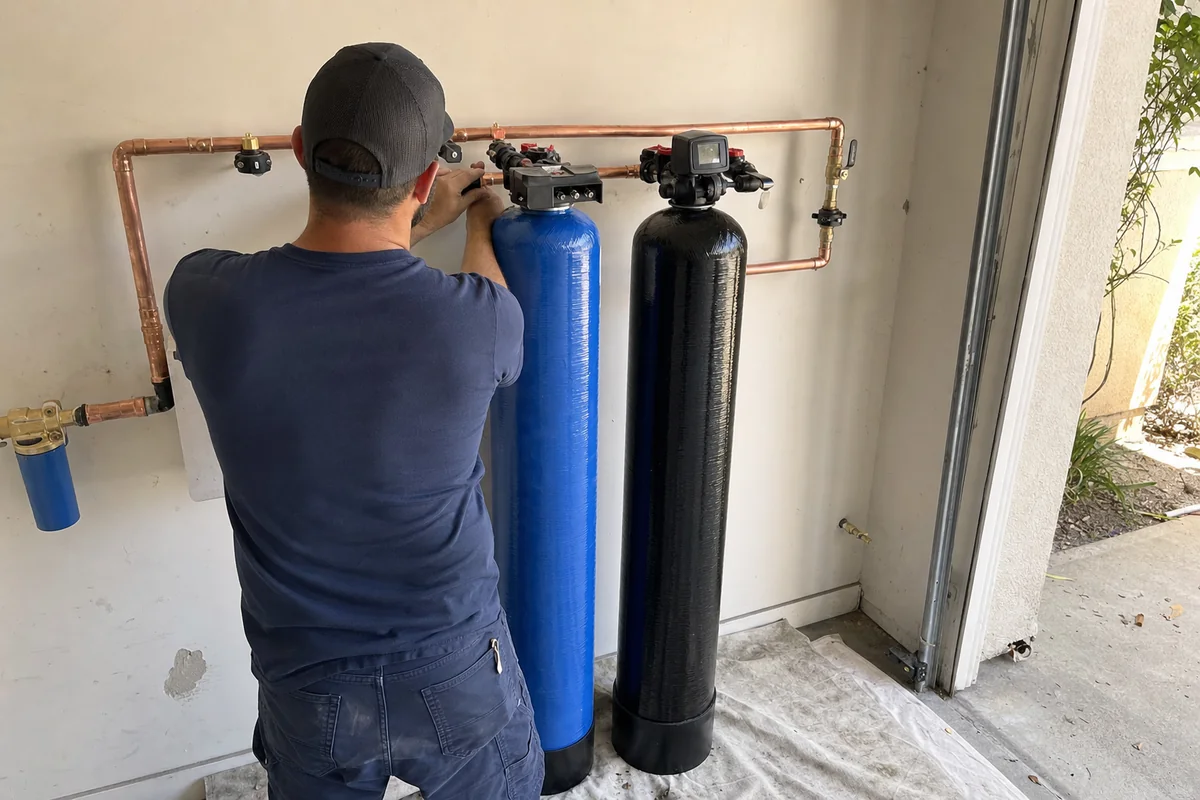
Most of my installs go in this order: a sediment filter first to catch sand and grit, then carbon, then the softener or conditioner. Want drinking water even cleaner than that? A small reverse osmosis system under the kitchen sink is the next step.
Can You Put In a Softener Yourself?
Some handy folks do. If you're fine cutting into copper or PEX on your main line, a basic single-tank unit is a weekend project. Where it goes wrong: no bypass valve, so you can't shut the softener off without shutting off the house. Or a drain line with no air gap, a small open space that stops dirty water from getting sucked back into your clean pipes. Or a slow leak at a push-on fitting behind the water heater that nobody sees for months.
If you want to do it yourself, call me anyway. I'll tell you what size to buy and what to watch for. What I don't do: sell salt delivery plans or pitch you a water test from a guy at the farmers market.
Water Softener Installation in Malibu, CA: What If It Acts Up Later?
If something I installed isn't right, I come back and make it right. That's Sergio's Done-Right Guarantee. For the equipment itself, the maker's warranty is in the paperwork I leave you, and I'll help you use it if a valve or control head fails.
Most problems later are simple: the salt bridges into a hard crust, a filter is overdue, or the bypass got bumped. I'll show you how to check those so you're not stuck waiting on me.
What to Expect
Time: Most softener or filter installs take about half a day. If I have to run new pipe to reach a good spot, it can take a full day.
Mess: Your water is off for a couple of hours. I lay drop cloths, protect the floor, and haul away the boxes and any old unit.
Permits: If your job needs a permit from City of Malibu Building Safety, I tell you before we start and handle it.
Cost: Angi puts the national average for water softener installation at about $1,500. Single-tank salt-based units run $500 to $1,700 and salt-free systems $800 to $4,000, plus $5 to $10 for a 40-pound bag of salt. Those are national numbers, not my prices. For water softener installation in Malibu, CA, you get my price in writing before any work starts.
Hard to very hard. District 29's 2025 report shows hardness from the Weymouth plant at 189 to 280 parts per million, average 234, and 137 to 142 from the Jensen plant. The USGS calls anything over 180 very hard. That's roughly 8 to 16 grains per gallon. Your bill tells you if you're on District 29.
Do I need a softener or just a filter?
It depends on what bugs you. If it's crust, spots and dry skin, that's hardness, and a softener fixes it. If it's chlorine taste or smell, that's a carbon filter job. Plenty of homes want both. I'll look at your fixtures and water report and tell you straight which one you need.
Will a softener add salt to my drinking water?
A salt-based softener adds some sodium. District 29's report already lists sodium from the Weymouth plant at about 89 parts per million before any softener. If you watch your salt, I can leave one kitchen tap on unsoftened water or add a reverse osmosis filter for drinking and cooking.
Is a salt-based softener OK with a septic system?
It can be, but the salty rinse water goes into your tank and leach field. Malibu relies on septic systems for most of its wastewater, so I bring this up on every job. If you're unsure, I'll talk it through with you and your septic service, or we look at salt-free instead.
How often do I add salt or change filters?
Check the salt tank about once a month and keep it a third to half full. Sediment filter cartridges usually need changing every few months. A big carbon tank often lasts several years, depending on how much water you use. I'll write the schedule on the unit so you don't have to remember.
Tired of Scrubbing Crust Off Everything?
Call or text Sergio at (310) 359-0140. We'll read your water report together and you get a straight price.